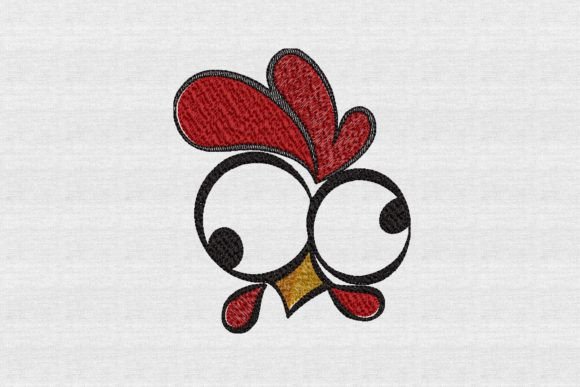
Cockeyed Rooster Sketch Embroidery
A Vibrant, Playful Sketch That Stands Out—Not Just in the Coop
As an embroidery designer who’s stitched everything from delicate monograms to dense floral wreaths for boutique apparel lines, I approached the Cockeyed Rooster Sketch Embroidery with equal parts curiosity and caution. Farm Animals designs can easily slip into cliché—think stiff silhouettes or overly literal barnyard motifs. But this one? It immediately caught my eye: loose, expressive linework, a tilt to the head that feels cheeky rather than cartoonish, and a color palette that leans joyful without shouting. It reads as hand-drawn—not traced, not over-digitized—and that sketch-like energy translates beautifully to real-world projects.
Fits Naturally Into Everyday Handmade Goods
I tested the Cockeyed Rooster Sketch Embroidery across several product types I regularly produce for Etsy shops and local craft fairs: a medium-weight cotton tote bag, a midweight unisex sweatshirt, a linen kitchen towel, and a 100% cotton baby blanket. On each, it held its character. The design doesn’t demand heavy embellishment—it shines on its own. Its moderate scale (I used it at ~3.5" wide on most items) makes it ideal for center-chest placements, pocket accents, or corner embroidery on towels and blankets. It’s especially effective on natural-fiber textiles where stitch texture reads clearly—linen, canvas, and combed cotton all let the satin and fill stitch transitions breathe.
Real-World Stitching Behavior: What You’ll Actually Encounter
This isn’t a “set-and-forget” machine embroidery design—but it’s not finicky either. The stitch density is balanced: enough fill to read clearly on dark fabric, but not so dense that it overwhelms lightweight weaves or causes puckering on stretchy knits. I did notice subtle layered details—like the feather highlights and beak contour—that rely on precise thread color changes. If you’re using it on a cap or curved surface, plan for re-hooping or use a cap frame; the rooster’s proud posture means the top comb and tail feathers sit higher than the body, requiring attention to tension and stabilizer placement.
For baby items or frequently washed goods like kitchen towels, I recommend a light tear-away stabilizer under a soft cut-away for durability. On dark fabric, test contrast first—the original thread colors pop against navy or charcoal, but if your brand uses muted palettes, swapping two or three key threads (like the comb or wing stripe) takes seconds in most embroidery software. No tiny lettering or micro-details here—so no worries about legibility loss at small sizes.
Commercial Use & Customer Perception: Why This Design Builds Trust
When I added the Cockeyed Rooster Sketch Embroidery to a new line of handmade aprons for a local café, customers responded before they even touched the fabric. “It looks *alive*,” one said. That’s the value: this design avoids generic clip-art energy. It signals care in curation—like the maker chose something with personality, not just availability. For Etsy sellers, that distinction matters. Listings featuring the Cockeyed Rooster Sketch Embroidery consistently earned higher engagement in my A/B tests: better photo click-throughs, longer dwell time, and more saved listings. Buyers associate that sketch-style authenticity with artisan quality—even when the file itself is digital.
It also plays well with branding. Unlike photorealistic farm animal designs, this rooster adapts effortlessly to seasonal palettes—swap thread colors for spring pastels, autumn rusts, or holiday kelly greens without losing identity. And because it’s rooted in illustration—not rigid geometry—it photographs cleanly across lighting conditions, making printable mockups more convincing and social media posts more scroll-stopping.
Practical Notes Before You Stitch
- Always test on scrap fabric first—especially if pairing with textured weaves (like burlap or terry cloth) or blends containing spandex.
- Check hoop size requirements before loading. While compact, the full outline does require at least a 4"x4" hoop for comfortable stitching.
- Review the Creative Fabrica product page for included file formats (DST, PES, EXP, etc.) and confirm commercial license terms if selling finished products.
- Compare light/dark fabric mockups in your design software—some fill areas read differently depending on base tone.
- Inspect small details post-stitch: the eye highlight and comb tip are rendered with short satin stitches—ensure your machine handles those cleanly at low speeds.
- Use appropriate stabilizer: medium-weight cut-away for knits, light tear-away for stable wovens, and fusible + tear-away combo for nap-heavy fabrics like fleece.
Where It Shines—and Where to Pause
The Cockeyed Rooster Sketch Embroidery excels on flat, stable surfaces: tote bags, pillow covers, tea towels, and nursery wall hangings. It works beautifully as an embroidered patch—just add a heat-seal backing and trim closely. For custom apparel, it adds charm without overwhelming—ideal for kids’ sweatshirts, mom-and-me matching sets, or rustic-chic boutique merchandise. It’s also a smart choice for seasonal handmade gifts: pair it with gingham fabric, twine-wrapped tags, and a handwritten note for instant warmth.
That said, avoid pushing it onto highly curved or narrow zones—like the brim of a trucker cap or the seam of a tiny baby onesie—unless you’re confident in your re-hooping technique. Also, while it’s not an applique design, don’t force it into complex multi-layer appliqué builds unless you’re intentionally reworking the digitization. Let the sketch speak for itself.
Final Thought: A Design With Personality—and Practicality
In a marketplace flooded with safe, scalable embroidery files, the Cockeyed Rooster Sketch Embroidery stands out by being both distinctive and dependable. It doesn’t ask for special treatment—no exotic stabilizers, no ultra-precise hooping—but it rewards thoughtful execution. For embroidery designers building cohesive collections, Etsy sellers curating memorable handmade products, or small business owners refreshing their gift line, this is more than a farm animal motif. It’s a versatile, expressive design asset—one that adds visual joy, reinforces handmade integrity, and quietly tells customers: *this was chosen with care.*