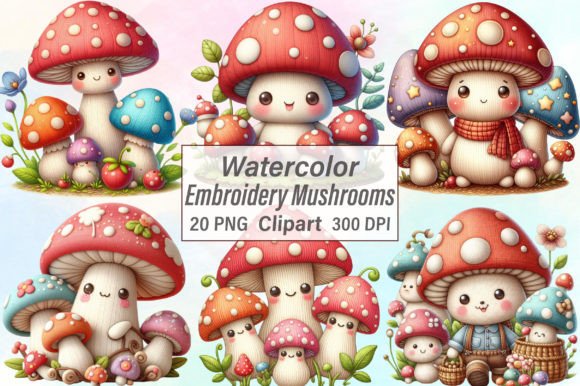
Watercolor Embroidery Mushrooms Clipart
A Seasonal Designer’s First Impression: Cozy, Whimsical & Gift-Ready
As an embroidery designer who’s built holiday collections for over a decade—from forest-themed Christmas markets to spring baby showers—I opened Watercolor Embroidery Mushrooms Clipart expecting charm. What I found was more: a cohesive, emotionally resonant set that lands squarely in the “cozy whimsy” sweet spot—equal parts nostalgic woodland magic and modern handmade elegance. The soft watercolor bleed, gentle gradients, and organic outlines evoke mushroom foraging on misty autumn mornings or quiet spring gardens—not cartoonish or kitschy, but quietly joyful and deeply seasonal. This isn’t just clipart; it’s mood-driven Illustrations with inherent storytelling power.
Where It Shines: Real Holiday Product Applications
In my shop planning for Q4 and early spring launches, Watercolor Embroidery Mushrooms Clipart fits seamlessly across high-demand categories:
- Sweatshirt embroidery — Large, breathable designs on oversized crewnecks create instant “cottagecore cozy” appeal for family matching sets and teen gift bundles.
- Tote bag design — At 12×12 inches and 300 dpi, these scale beautifully for medium-to-large canvas totes—ideal for farmers’ market shoppers, craft fair vendors, and eco-conscious givers.
- Kitchen towel embroidery — The soft edges translate well to linen and cotton terry; pair with subtle script (“Foraged with Love”) for artisanal home goods.
- Pillow cover and apron applications feel natural—mushrooms add texture without visual clutter, reinforcing warmth and handcrafted care.
- Embroidered patch collections? Yes—convert individual mushrooms into iron-on or sew-on patches for jackets, backpacks, or baby onesies (think woodland-themed baby showers).
- For personalized gift listings on Etsy, use one mushroom as a focal point on a monogrammed mug sleeve or custom table runner—pairing effortlessly with neutral palettes and botanical accents.
On social media previews and printable mockups, these graphics generate strong visual recognition—soft color variation reads clearly even at thumbnail size, and the transparent background makes staging effortless across lifestyle photos and flat lays.
Where to Proceed Thoughtfully: Practical Embroidery Notes
While Watercolor Embroidery Mushrooms Clipart is versatile, its artistic style demands intentional execution—especially for machine embroidery design and finished product durability:
- Hoop size: Designed at 12×12 inches, this set suits larger hoops (6"–8") best. Avoid shrinking below 4" unless simplifying details—fine stems and cap textures may lose clarity.
- Stitch density: Watercolor shading implies layered fills—confirm stitch count if converting to embroidery file formats. High-density areas need proper stabilizer, especially on lightweight knits or stretchy garments.
- Fabric texture: Works beautifully on stable weaves (linen, quilting cotton, midweight denim), but test first on thick towels or textured burlap—soft gradients can blur if stitches don’t anchor cleanly.
- Dark fabric: The transparent background helps, but watercolor tones rely on luminosity—always test thread colors on black or navy; consider tone-on-tone stitching or light underlay for definition.
- Metallic thread or delicate sheers? Not ideal—the subtlety of watercolor relies on matte, blended tones. Save metallics for crisp line-art versions.
- Curved caps and repeated washing: Prioritize low-density fill options and secure satin borders when digitizing—this isn’t a heavy-duty workwear motif, but a gentle seasonal statement.
Why It Elevates Your Seasonal Embroidery Strategy
Watercolor Embroidery Mushrooms Clipart does more than decorate—it deepens customer connection during high-intent shopping windows. Its emotional tone builds trust: shoppers recognize authenticity, craftsmanship, and intentionality. That translates directly to giftability. A mushroom-embroidered tea towel feels like a curated, thoughtful present—not mass-produced, but made with care. For Etsy sellers and small shop product creators, this aesthetic strengthens brand consistency across product lines: imagine coordinating sweatshirts, patches, and greeting cards—all unified by the same soft, earthy language.
It also boosts engagement: holiday shoppers scroll fast, but gentle watercolor motifs pause attention. On Instagram Reels or Pinterest pins, these designs stand out against bold typography or neon trends—offering calm, warmth, and quiet sophistication. And because they’re rooted in nature and seasonality, they avoid trend fatigue. You won’t need to retire them after December—they flow naturally into spring showers, Easter gatherings, and Mother’s Day brunches.
Designer-to-Designer Checklist Before Launch
Before adding Watercolor Embroidery Mushrooms Clipart to your seasonal embroidery lineup, run through these practical steps:
- Test thread colors on both light and dark fabric swatches—note how watercolor transitions hold up in stitch.
- Verify hoop size compatibility with your most-used machines—and confirm whether you’ll need to resize or simplify for smaller items like ornaments or baby bibs.
- Choose the right stabilizer: cutaway for knits, tear-away for stable wovens, and optional topping for fuzzy fabrics like terry cloth.
- Create realistic printable mockups—don’t rely on digital-only previews. See how the design flows on actual garment drape and fabric texture.
- Review small details post-stitch: caps, gills, and stem bases should read clearly—not muddy or pixelated—even at reduced scale.
- Plan a cohesive matching color palette across products (e.g., moss green, oatmeal, slate blue) to reinforce brand cohesion in listings and packaging.
- Confirm commercial licensing terms before selling finished seasonal products—since this is a digital embroidery file and Graphics bundle, rights for resale of physical items must be explicitly permitted.
Bottom line? Watercolor Embroidery Mushrooms Clipart isn’t just another holiday graphic—it’s a strategic seasonal asset. When thoughtfully digitized, tested, and styled, it transforms everyday items into heartfelt, memorable handmade gifts—and that’s exactly what sells when shoppers are choosing meaning over mass.