Dragonfly Embroidery Designs
First Impression: Elegant, Detailed, and Instantly Recognizable
As an embroidery designer who’s prepped over 200 craft fair booths—and shipped thousands of finished products—I opened Dragonfly Embroidery Designs expecting charm. What I got was quiet confidence: a machine embroidery design that reads as elegant, not cutesy; detailed, not fussy; natural, not cartoonish. It lands squarely in the “premium handmade” lane—ideal for boutique makers, Etsy sellers, and small shop owners who curate rather than clutter. Unlike many Bugs category designs that lean playful or cartoon-forward, this one breathes sophistication. It feels like something you’d see on a linen tea towel at a curated home goods pop-up—not a plastic badge at a kid’s birthday party.
Where Dragonfly Embroidery Designs Shines on Craft Fair Products
This design isn’t just versatile—it’s *strategic*. Here’s where it delivers real selling power:
- Tote bag design: Works beautifully centered on the front panel of medium-weight canvas or natural cotton totes. The dragonfly’s wings catch light, adding subtle movement even when static—making your booth display feel alive.
- Apron embroidery: Perfect above the pocket or along the waistband. Its vertical orientation mirrors apron structure, and the fine wing detail reads as intentional craftsmanship—not filler.
- Tea towel embroidery: A standout on flour-sack or Belgian linen. The design’s balance between open space and intricate line work prevents visual fatigue—a critical win for kitchen-focused shoppers who scan quickly.
- Embroidered patch: Holds up well at 2.5"–3.5" sizes. Clean outer edges and moderate stitch density mean it’ll fuse or sew cleanly onto denim jackets, market bags, or pouches without puckering.
- Pillow cover & small pouch: Scales elegantly down to 4" wide. Customers notice the delicacy—not the difficulty—making it ideal for giftable handmade products with perceived value.
What Buyers Actually See (and Why They Stop)
At a craft fair, attention lasts 3 seconds. Dragonfly Embroidery Designs earns those seconds because it balances contrast, clarity, and character. On a dark fabric? Use high-contrast thread colors—ivory on charcoal, mint on navy—to preserve wing definition. On textured towels? Avoid ultra-dense fill areas; the description mentions “intricate patterns,” so test stitch density early. If tiny wing veins vanish into terry loops, simplify or adjust underlay. This isn’t a design that hides—it invites closer inspection, which drives engagement, questions, and sales.
Production Realities: Smart Scaling, Not Just Pretty Stitches
Yes, it’s beautiful—but can you produce it reliably across 30 tote bags before Saturday morning? Here’s what matters:
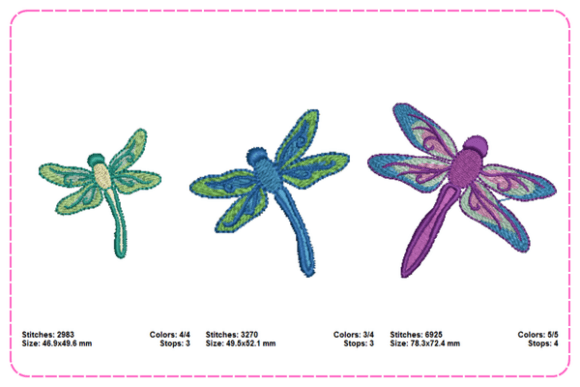
- It works at multiple sizes: As a small accent (1.75") on a cap brim or pouch corner—or large (5.5") as a focal point on a pillow cover. That flexibility means fewer files to manage and more cohesive branding across your product line.
- It photographs exceptionally well: Clean lines, balanced negative space, and organic flow translate clearly in natural-light Etsy listings and printable mockups. No heavy editing needed—just consistent fabric lighting.
- It’s batch-friendly: Moderate stitch count (implied by “crafted to perfection” and “fine details”) suggests thoughtful digitizing—not excessive travel stitches or nested fills. That means smoother hooping, fewer thread breaks, and steadier output during peak craft fair prep.
Careful-Use Notes Every Designer Should Check
Don’t assume—verify. Before cutting fabric or listing on Etsy:
- Test the embroidery file on scrap fabric matching your final product—especially for thick canvas, textured tea towels, or curved cap surfaces.
- Review spacing between wing elements: tight gaps may collapse on dark fabric or low-thread-count cotton.
- Check if any wingtips or antennae fall below 1.2mm width—those may disappear on dense weaves or when stitched too fast.
- Confirm hoop size compatibility. If your primary machine uses 4x4 hoops, ensure the smallest usable version fits without distortion.
- Assess stabilizer needs: lightweight cutaway for knits, tear-away for stable wovens, and fusible + tear-away for towels.
How Dragonfly Embroidery Designs Strengthens Your Brand—Not Just Your Booth
This isn’t just another digital embroidery file. It’s a consistency anchor. When repeated across your tote bags, patches, and pillow covers, it builds recognizable design assets—something buyers remember and seek out. It elevates perceived handmade quality without screaming “handmade.” It supports brand storytelling: think “slow craft,” “nature-inspired utility,” or “quiet luxury”—not novelty. At a crowded fair, that cohesion makes your table feel intentional, not improvised. And for Etsy sellers? It improves search relevance for terms like “elegant dragonfly embroidery,” “botanical machine embroidery,” and “premium bug design”—without leaning into overused tropes.
Final Designer Checklist Before You Sell
Before turning Dragonfly Embroidery Designs into a craft fair product or commercial embroidery offering:
- Run a test stitch on your target fabric—and compare thread colors in daylight and store lighting.
- Create at least one real mockup (not just a digital preview). Hold it in your hand. Does the scale feel right? Does the detail hold up?
- Review spacing, stitch density, and edge sharpness at actual size—not zoomed in on screen.
- Confirm commercial licensing applies to finished products (the description says “crafted to perfection for those who cherish fine details,” but verify usage rights before selling).
- Document your settings: stabilizer type, needle size, thread brands, and machine speed. Reproducibility is your profit margin.
Bottom Line for Creative Entrepreneurs
Dragonfly Embroidery Designs isn’t flashy—but it’s memorable. It doesn’t shout; it lingers. For the embroidery business owner juggling Etsy listings, craft fair deadlines, and wholesale inquiries, it’s a rare find: a machine embroidery design that sells both online and in person, scales across categories, and reinforces quality without requiring explanation. Whether you’re stitching on aprons for a local café or creating giftable pouches for holiday markets, this design earns its place—not as decoration, but as intention made visible. And in handmade commerce, that’s the highest compliment of all.